How to Answer UC Personal Insight Questions (PIQs): The Complete Strategy Guide for Applicants
Updated: Apr 30

At some point in the last few months, if you're being honest, you've asked yourself a version of this question: Am I actually interesting, or have I just been good at school?
It's uncomfortable. But it's also, almost exactly, what the UC Personal Insight Questions (PIQs) are designed to find out.
The IB Diploma has spent two years training you to do something specific: identify a position, build a case for it with evidence, address the counterarguments, and reach a defensible conclusion. That training works well. It's part of why IB graduates tend to perform strongly in university coursework, and it's part of what's gotten you this far.
It is also, when applied to a PIQ, almost entirely the wrong instinct.
UC admissions readers evaluate thousands of applications every cycle from students who have been prepared, coached, and trained to present themselves as impressively as possible. After a while, they become very good at spotting the difference between a response that has been constructed and one that has been lived. The constructed response reads as correct.
The lived response reads as real.
For Fall 2025, UC Berkeley received applications from 24,040 international students and admitted 1,469, an acceptance rate of 7.33%. At UCLA, the overall admit rate was 9%, with international students closer to 6%. In pools that tight, students on both sides of the decision mostly have strong grades and credible profiles. What separates them, in a meaningful number of cases, is whether their PIQs say something real about who they are.
This guide is about how to make yours do exactly that.
The UC Application: What Makes It Different
Before you write a single word, one thing needs to be clear: the University of California does not use the Common Application.
The UC system runs its own portal at universityofcalifornia.edu, on its own timeline. One application covers all 9 UC campuses simultaneously: Berkeley, UCLA, UCSD, UC Davis, UC Santa Barbara, UC Irvine, UC Riverside, UC Santa Cruz, and UC Merced. You choose which campuses to include, but the 4 PIQs you write go to every one of them.
The application opens on August 1 each year. The submission deadline is November 30.
That November 30 date is where a lot of international students run into trouble. It falls right in the middle of Common App season, when students from India, the UAE, Singapore, and the UK are typically deep into their personal statements and supplemental essays for other universities. The UC application gets pushed to the last two weeks of November, when writing energy is depleted and the deadline is imminent. This is, consistently, how otherwise strong applications end up with PIQs that feel rushed.
Start your PIQ brainstorming no later than early September. The actual writing, revision, and iteration takes three to five weeks when done properly. That time does not exist in the last fortnight of November.
One more thing: the UC application includes an Additional Comments field of 550 characters. A grade dip in one semester, a medical situation, a school disruption, a gap in your activities record: this is where that context belongs. Many students don't know this field exists and waste a PIQ slot on explanation. Save your PIQs for substance.
How the UC Actually Evaluates Your Application
This is the part most applicants skip, and it's worth reading carefully.
The UC uses a process called comprehensive review. The phrase gets used a lot in college admissions, but the UC's version has specific mechanics that directly affect how you should approach your PIQs. UC Berkeley, which pioneered the process, describes it this way: no single piece of information is weighted more heavily than another. Your GPA matters. So does what you've done with the resources you had. So does what you say in your essays.
There are 13 factors the UC considers in evaluating every application. All campuses use the same 13, but the weight each campus gives to individual factors can differ from campus to campus and from year to year. Understanding what these factors are, and which ones your PIQs directly speak to, is one of the most useful things you can do before you start writing.
The academic factors (1 to 9) cover:
GPA in completed A-G courses,
Performance beyond the minimum course requirements,
Performance in Honors, AP, and IB Higher Level courses specifically,
Whether you are identified as being in the top 9% of your high school class at the end of junior year (known as Eligible in the Local Context or ELC),
The quality of your senior-year course load,
How your academic performance compares to the educational opportunities your school made available to you,
Outstanding performance in a particular subject area,
Outstanding work in a special academic project, and
Recent marked improvement in academic performance.
Two of these are worth highlighting for IB students. Factor 3 names IB Higher Level courses specifically as a recognized form of academic rigor. Factor 6, which assesses your performance relative to what your school made available, means a strong record at a school with limited resources carries real weight. It also means an average record at a school with exceptional resources carries less of it.
The personal factors (10, 11, and 12) are where your PIQs do their most direct work.
Factor 10 covers special talents, achievements, and awards in any field: visual and performing arts, communication, or athletics. It also includes special skills such as demonstrated proficiency in other languages, special interests such as deep study of other cultures, and experiences that demonstrate unusual promise for leadership, including significant community service and student government participation. Any significant experience or achievement that demonstrates your potential to contribute to the intellectual vitality of the campus falls here.
Factor 11 covers the completion of special projects in the context of your school curriculum or in connection with school events and programs.
Factor 12 covers academic accomplishments in light of life experiences and special circumstances, including disabilities, low family income, being the first in your family to attend college, having to work, a disadvantaged social or educational environment, difficult personal or family situations, refugee status, and veteran status.
The contextual factor (13) is the location of your secondary school and your place of residence. Geographic diversity across states and countries is a genuine consideration. Applying from India, the UAE, Singapore, or the UK is not a disadvantage. In many cases, it is the opposite.
One additional point that students frequently don't know: each UC campus evaluates your application without knowing the status of the same application at any other campus. Campuses do not consider where else you have applied, and they do not know whether another campus has admitted or rejected you. All 9 campuses review your application at the same time, but completely independently of one another. This means your application to UC Davis is evaluated entirely on its own terms, regardless of what Berkeley decided.
The UC also states clearly that its undergraduate admissions process does not discriminate against, or provide preferential treatment to, any individual on the basis of race, sex, colour, ethnicity, or national origin.
What this means for your PIQs in practice
Factors 10, 11, and 12 are the ones your PIQs are best positioned to address. Factor 10 in particular covers almost everything a well-chosen set of 4 PIQs can demonstrate: talent, leadership, community contribution, intellectual engagement, and personal depth. Your academic record speaks to factors 1 through 9. Factors 10 through 12 largely depend on how well you write.
One more thing worth noting: UC Berkeley explicitly states that portfolios, resumes, and other supporting materials are not considered during the review process. What counts is your reported grades, test scores, extracurricular activities, PIQs, and the Additional Comments field. Nothing else. The PIQs carry more weight in your application than many students realize.
What UC Personal Insight Questions (PIQs) Are, and What They Are Not
The UC calls them Personal Insight Questions, not essays. That choice of language is intentional.
PIQs are not a version of your Common App personal statement. They are not a place for a broad narrative about your life and ambitions. They are also not a prose version of your activities list.
A useful way to think about what they are: imagine a conversation with someone from the UC who has your grades and your activities list already in front of them. What would you want them to know about you that those numbers and lists don't show? Each PIQ is one focused, honest answer to one specific question.
350 words is roughly one side of A4, typed in 12-point font. A practical way to think about pacing within that space:
Opening (40-50 words): Ground the reader in a specific moment, scene, or observation. Don't introduce yourself by name. Don't open with a quote or a definition. Start with something that immediately signals what this answer is about.
Core content (240-260 words): Answer the question. Be specific. Show your thinking, not just your actions.
Reflection and close (50-60 words): Connect what you've described to something larger: a value, a realization, a direction. One or two sentences is often enough. You don't need to resolve everything neatly.
Going significantly under 300 words reads as low effort. The portal won't let you exceed 350. Aim to land between 340 and 350.
Using AI to Write your UC Personal Insight Questions?
With the growing availability of AI tools (ChatGPT, Claude, etc.), you might be tempted to use them to write essays, be it the UC PIQs, or other essays such as Common App essay, UCAS Personal Statement, or supplemental essays. Is that a wise approach? How low should your AI Detection score be? What do Universities have to say regarding this issue? Click the button to know more
The 8 Questions: What They Ask and How to Approach Each
Here, for each question, we will first present a screenshot of what the University of California system has mentioned followed by our commentary on the same
PIQ #1: Leadership
Describe an example of your leadership experience in which you have positively influenced others, helped resolve disputes or contributed to group efforts over time.

The UC's guidance for this prompt is deliberately broad. What it doesn't say, but what experienced readers will confirm, is that the weakest responses are the ones where nothing is at stake.
A leadership essay with a cooperative team, an obvious right answer, and a clean outcome tells a reader you were competent. That's not nothing, but it isn't enough in a competitive pool. What makes a response genuinely strong is a moment where you had to make a judgment call that cost something, where the easier path existed and you chose not to take it, and where you can describe exactly what that decision required of you.
Do's
Focus on one specific decision or moment within the experience, not a summary of your entire tenure in the role
Describe the tension: what the easier choice was, why you didn't take it, and what it actually felt like to choose differently
Show how the experience changed your understanding of what it means to be responsible for other people
Use concrete detail throughout: a specific conversation, a specific day, a specific number
Don'ts
Don't open with your title: "As President of..." is one of the most common first lines on this prompt and one of the weakest
Don't list what you accomplished in the role; the UC already has your activities list
Don't write about a situation with no genuine difficulty or disagreement
Don't spend more than 60 words on background before getting to the actual moment you're writing about
PIQ #2: Creativity
Every person has a creative side, and it can be expressed in many ways: problem solving, original and innovative thinking, and artistically, to name a few. Describe how you express your creative side.
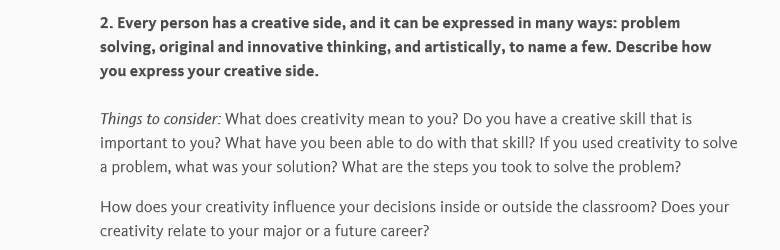
The prompt defines creativity broadly, and that breadth is also where most responses go wrong. Because the definition is so wide, students tend to write in general terms about how they think rather than showing the reader something specific they made or did. Responses full of phrases like "thinking differently" or "finding unexpected connections" are common on this prompt, and they tell a reader almost nothing.
The most useful PIQ 2 responses are built around one specific creative act: a project, a piece of work, a problem solved in a way that was genuinely surprising. Not a description of your creative tendencies in the abstract, but a particular thing that would not have existed without you.
Do's
Anchor the entire response in one specific work or moment rather than a general account of how you approach problems
Bring the actual idea to life for the reader: what made it unusual, what it was trying to do, what it was responding to
Let the creative act appear early in the response, and build from it rather than toward it
Don'ts
Don't open with a personality description: "I have always been someone who sees things differently" tells the reader nothing
Don't list multiple creative pursuits: one thing examined closely will always outperform three things mentioned briefly
Don't save the specific work for the final paragraph; if the reader gets there and is only just finding out what you actually made or did, the structure needs rethinking
PIQ #3: Talent or Skill
What would you say is your greatest talent or skill? How have you developed and demonstrated that talent over time?

Most students approach this prompt by describing their talent from the outside: what it looks like, what they've achieved with it, where they've performed or competed. The problem is that this is the least interesting angle from which to write about a skill you've spent years developing.
What makes this prompt work is writing from the inside: not what the talent looks like to someone watching, but what developing it over years has actually done to you. What it has changed in how you pay attention, how you process difficulty, how you think about something else entirely. A decade of serious training in any discipline tends to produce a specific kind of mind. That is what this prompt is asking about.
Do's
Go deep on one talent rather than touching on several
Look for a connection between your talent and your intended field of study that the reader wouldn't automatically expect
Describe a specific moment of difficulty or breakthrough in the development of the skill, not just its current polished state
Write from inside the experience of developing the skill, not from a spectator's view of what it has produced
Don'ts
Don't write a performance history or timeline of achievements; that is a list, not a PIQ
Don't choose the most impressive-sounding talent if a quieter, more personal one would produce a more honest essay
Don't leave the reflection for the last two sentences; the insight should run through the whole response, not arrive as a conclusion
PIQ #4: Educational Opportunity or Barrier
Describe how you have taken advantage of a significant educational opportunity or worked to overcome an educational barrier you have faced.

This prompt gives you two paths: an opportunity you took, or a barrier you worked through. Most students take the opportunity path because it feels safer. That instinct is understandable, and the result is that the barrier path is significantly less crowded. When written honestly, barrier essays tend to produce more compelling responses, because genuine difficulty is more revealing than access to resources.
Whether you write about an opportunity or a barrier, the structural trap is the same: the prompt pulls strongly toward the descriptive and away from the reflective. Students describe what the experience was rather than what it changed. The responses that stand out describe both, with the weight on the latter.
Do's
Make the central question of the essay "what did this change in me" rather than "what was this"
If writing about an opportunity, describe what you did with the specific access it gave you, not just what the experience felt like
If writing about a barrier, be direct about what it cost you; essays that soften the difficulty of a genuine obstacle tend to soften the reader's interest too
Connect the experience clearly to where you are heading academically
Don'ts
Don't write a program description; if you attended a summer school or enrichment course, the essay is not about the program, it's about what you did with what it gave you
Don't end with a general statement about gratitude; it closes an essay that should stay open
Don't use the barrier path primarily as a vehicle to explain a weakness in your application without genuinely engaging with what the barrier revealed
PIQ #5: Significant Challenge
Describe the most significant challenge you have faced and the steps you have taken to overcome this challenge. How has this challenge affected your academic achievement?

Two things go wrong on this prompt more than any other.
The first is underplaying. Students who have faced a real and significant challenge choose not to write about it because it feels too personal or too negative, and write about something smaller instead. The stakes aren't there, and a reader can feel that.
The second is the redemption arc. Students write about a genuine difficulty but frame the entire response as a clean three-act story: struggle, effort, triumph. These essays are structurally recognizable from the first paragraph, and they flatten the actual complexity of what the student went through.
The responses that work resist both traps. They describe what the challenge actually cost and what it revealed, without requiring a neat resolution at the end. One point that students frequently miss: the prompt specifically asks how the challenge affected your academic achievement. This is not a suggestion. If your challenge had any bearing on your academic record, address it directly.
Do's
Be specific about what the challenge actually felt like, not just what it objectively was
Address the academic impact directly, as the prompt asks
Show what the challenge changed or revealed, even if that change is still in progress
Write a response that only you could have written; if the essay could belong to any student who went through something similar, it isn't specific enough yet
Don'ts
Don't frame the response as a recovery narrative with a tidy ending
Don't write about a challenge so broadly experienced that nothing specific to you appears on the page
Don't open with "The most significant challenge I have faced is..."; the prompt has already given you that sentence
PIQ #6: Academic Subject
Think about an academic subject that inspires you. Describe how you have furthered this interest inside and/or outside of the classroom.
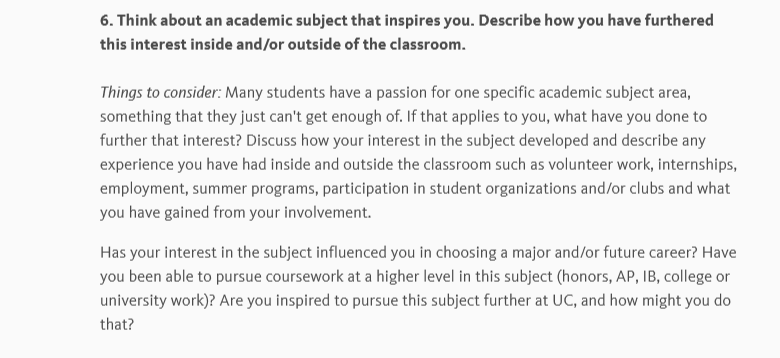
This is the prompt where the gap between genuine and performed intellectual enthusiasm is most visible. UC readers see a large number of responses from students who say they are passionate about a subject and then describe their coursework. Coursework is expected. It is the starting point for this PIQ, not the evidence.
The students who write strong responses on this prompt can point to a specific question within the subject they couldn't stop turning over, describe what they did outside the classroom to try to answer it, and show how that process changed their understanding of the field. Not a general enthusiasm for the subject. A particular thread they pulled, and what came loose when they did.
Do's
Identify one specific question, problem, or idea and build the entire response around it
Show clearly how your thinking about the subject has evolved: where you started, what shifted, and where you are now
Connect your interest directly to your intended major and to what you want to pursue at UC
Don'ts
Don't open by defining the subject or describing it in general terms; a definition is not an insight
Don't use this prompt to catalogue your grades, awards, or achievements in the subject; those belong in the application, not the PIQ
Don't write about a subject because it sounds impressive; the difference between genuine and performed enthusiasm is easy to read in 350 words
Don't end with a vague statement about wanting to explore this further at UC without specifying what aspect and why
PIQ #7: Community
What have you done to make your school or your community a better place?

Because this prompt defines community so broadly, responses tend to stay at the level of summary. Students describe their contribution in general terms: numbers reached, outcomes produced, impact created. What's missing is the texture of the actual work: the specific conversations that didn't go as planned, the resistance that required rethinking, the moment when the approach had to change.
The responses that work on this prompt are built around the reality of doing the thing, not the report of having done it. A reader who finishes your PIQ 7 should feel like they were in the room while the work was happening, not like they read a summary of it afterwards.
Do's
Focus on one contribution and go deep rather than referencing several
Include the specific difficulty: what didn't work, who pushed back, what you had to learn about the community or the problem that you didn't know at the start
Write a response that could only have come from your specific experience of this particular community and this particular effort
Don'ts
Don't lead with outcomes and impact numbers without showing the human reality that produced them
Don't write a response so generic that it could have been written by any student who ran the same program or joined the same club
Don't skip the difficulty; a community contribution with no resistance and only positive results reads as a summary of a project plan, not an account of actual experience
PIQ #8: Why You
Beyond what has already been shared in your application, what do you believe makes you a strong candidate for admissions to the University of California?

The phrase "don't be afraid to brag a little" in the UC's guidance gets misread more often than any other instruction in the application. Students interpret it as an invitation to summarize their achievements. The UC already has your transcript, your activities list, your test scores, and three other PIQ responses. A PIQ 8 that recaps what those documents already show wastes 350 words telling a reader something they already know.
What this prompt is asking for is synthesis. Looking at everything in this application, what would a reader miss if they only looked at the data? What is only visible when you connect things that appear separately, or surface something that hasn't appeared at all?
The single most useful thing you can do before writing this PIQ: read your other 3 responses and your activities list and identify the gap. What is true about you that isn't in any of it?
Do's
Identify something genuinely new to say; if you're drawing connections between things already in the application, make sure the synthesis itself is the new contribution, not just a rearrangement of existing material
Be specific; a claim about having a unique perspective requires evidence, not just assertion
Use this prompt for something genuinely unusual about your profile that no other prompt captures well
Don'ts
Don't summarize your application; the reader has it open while reading your PIQs
Don't use this as a fourth chance to describe an activity already covered elsewhere
Don't treat this as a backup prompt when you couldn't find a better fit for a story; this is the hardest of the 8 to write well, and a weak response here is more noticeable than a weak response on a more specific prompt
Don't open with a list of achievements
How to Choose which four PIQs to answer from among the eight options: A 3-Step Framework
Step 1: The Brainstorm Audit
Before you look at the prompts with selection in mind, write down the 5 or 6 experiences from high school that have been most significant to you. Academic, extracurricular, personal, or community-related: the filter is not what sounds most impressive. The filter is what actually meant something.
These are your raw material. Prompt selection happens after you know what you have to work with.
Step 2: The Portfolio Check
Your 4 PIQs, read together, need to show a multi-dimensional picture of who you are. Think about four dimensions you want to collectively cover:
What excites you intellectually, and how your mind engages with a problem
How you operate when you are responsible for other people or a larger purpose
What you are like when circumstances work against you
Something about you that nothing else in the application is likely to capture
Map each of your top experiences to one of these dimensions. If everything maps to the same one or two categories, you have a portfolio problem that no amount of good writing will fix.
The selection needs to change before the writing begins.
Step 3: The Prompt Fit Test
Now look at the 8 prompts and identify which one each of your top experiences fits most naturally. A good fit should feel obvious. If you're significantly reshaping a story to suit a prompt, either the story or the prompt needs to change.
Since one application goes to every UC campus you apply to, avoid naming a specific campus in your PIQs unless you are applying to only one. A reference to "Berkeley's interdisciplinary culture" reads oddly on a UC Santa Barbara screen.
Your 4 PIQs Are a Set, Not Four Separate Essays
Once you have a shortlist of 4 prompts and the stories you plan to use for each, step back and look at the combination as a whole.
Your reader will encounter all 4 PIQs in sequence. The first creates the initial impression. The last is the one that stays. The two in the middle fill in the picture.
Ask yourself: if someone who had never met you read these 4 answers, what would they say about the person who wrote them? Would that description feel complete and dimensional, or would it keep returning to the same two or three things?
A strong 4-PIQ portfolio might look like this:
PIQ 6 shows what excites this person intellectually and how their mind works
PIQ 1 shows how they operate when they are responsible for others
PIQ 5 shows what they are like when things go wrong
PIQ 3 shows a side of them that nothing else in the application captures
Four distinct angles on the same person. That is what you are building toward.
Writing Principles That Apply to All 8 PIQs
Be specific rather than general.
"I learned a great deal from this experience" tells a reader nothing useful. "I realized I had spent six weeks optimizing for the metric my teacher was grading, not for the problem I originally set out to solve" tells them something real about how you think. In PIQs, specificity is the difference between a response that is believed and one that isn't.
Show the process, not just the outcome.
What you did matters. How you thought through it, especially when it was unclear or uncomfortable, matters more. The capacity to engage honestly with difficulty is exactly what UC readers are looking for, and it shows up in the thinking you describe, not only in the result you report.
Don't open with your name, your birthplace, or a quote.
All three are among the most common opening moves in student writing, and all three signal to a reader that what follows will be predictable.
Write in active voice.
"I restructured the program after the first session ran long" is stronger than "The program was restructured after the first session ran long."
A note for students writing in their second or third language
The PIQs do not reward literary sophistication. They reward clarity, specificity, and honesty. A simple sentence that is precise and true will always outperform a complex sentence that is approximate. Don't reach for vocabulary. Reach for accuracy.
Common Mistakes Across All 8 PIQs
Regardless of which four PIQs you have decided to answer, the following are mistakes you absolutely must avoid committing in any of those:
Writing about your most impressive experience rather than your most revealing one
Treating the PIQ as a bullet-point list rephrased into paragraphs
Using all 4 responses to tell variations of the same story
Burying the actual answer to the question in the final paragraph
Submitting a response significantly under 300 words
Leaning on abstract language ("passion," "resilience," "impact," "journey") without grounding any of it in a specific moment
Writing a perfect arc with no doubt or difficulty anywhere in it: these read as constructed, not lived
For International Applicants Specifically
The 13-factor comprehensive review framework applies equally to international applicants. There is no separate review track and no adjusted criteria. The factors that explicitly recognize life circumstances, geographic location, and the quality of performance relative to available opportunities are as relevant to a student in Hyderabad or Dubai as they are to a student in California.
Your international background is a genuine asset under Factor 13, which considers the location of your secondary school and residence as part of the review. Geographic diversity across states and countries is a real consideration, not a polite formality.
What you don't need to do is spend your word count educating the reader about your educational system. UC admissions staff are globally literate and experienced in reading IB transcripts, including the distinction between HL and SL subjects and the significance of predicted scores. A brief mention is enough. You do not need 80 words of a 350-word PIQ explaining what the IB is.
If you have attended multiple schools across different countries, PIQ 4 is a natural place to address that experience, but only if the transitions genuinely shaped your learning in a specific, describable way. An essay about moving schools is only interesting if moving schools actually changed something for you, and you can show what.
What Comes Next
The strategy in this guide gets you to the starting line. You understand what makes the UC application different, how the 13-factor comprehensive review actually works, how to select your 4 PIQs, and what each of the 8 prompts is genuinely testing.
What it doesn't do is show you what a strong PIQ answer looks and feels like on the page.
That is what Part 2 of this guide covers. Each of the 8 prompts gets two complete example answers from students whose backgrounds will feel recognizable to many of you reading this.
If you want personalized guidance on which 4 PIQs fit your specific profile and how to approach each one, our counselors at InkStudio work with students through every stage of the UC application process. Leave your details below and we will be in touch.
Frequently Asked Questions about the UC Personal Insight Questions (PIQs)
Do I write different PIQs for each UC campus I apply to?
No. You write one set of 4 PIQs and the same answers go to every campus you have applied to within the UC system. This is one of the main reasons to avoid campus-specific references in your responses.
Do different campuses weigh the 13 factors the same way?
No, and this is worth knowing. All 9 campuses use the same 13 factors, but the weight each campus gives to individual factors can differ both by campus and from year to year. This is one reason UC Berkeley, for example, may admit a student that UCLA does not, even with the same application. Reviewing the selection process page for each campus you are applying to is worth the time.
Does one campus know whether another campus has accepted or rejected me?
No. Each campus evaluates your application completely independently and without knowledge of your status at any other campus. The review happens simultaneously across all campuses you have applied to, but each campus makes its decision in isolation.
Can I write about the same experience I used in my Common App personal statement?
It's better not to. The PIQs give you 4 additional opportunities to show dimensions of yourself that your Common App essay doesn't cover. Repeating a story wastes one of those 4 slots.
Does the order in which I present my 4 PIQs matter?
The UC application doesn't prescribe a sequence, but the order in which a reader encounters your 4 responses does matter. Think about which answer makes the strongest opening impression, and which one you want to leave the reader with last.
I have a grade dip from one semester. Should I address it in a PIQ?
Not unless the circumstances were genuinely extraordinary and the story is compelling enough to carry a full PIQ on its own. In most cases, the Additional Comments field is the right place for contextual factors like grade dips, school transitions, or health situations.
How early should I start working on my PIQs?
Begin the brainstorming process no later than early September. The actual writing and revision typically takes three to five weeks when done well. Starting in late October leaves very little room for the kind of iteration that produces a strong final draft, and the November 30 deadline does not move.
I am an IB student. Do UC campuses understand the IB grading system?
Yes. The 13-factor review framework specifically names IB Higher Level courses as a recognized indicator of academic rigor under Factor 3. UC campuses are experienced in evaluating IB transcripts and understand the grading scale, the distinction between HL and SL subjects, and the significance of predicted scores. You do not need to explain the IB system anywhere in your application.



Comments